A Brief History of OCR
I am an archivist with the University of Idaho Library’s Special Collections and Archives department. We collect, preserve, and provide access to the university’s historical records and other unique historical materials related to this region and the state. We hold materials such as past university presidents’ correspondence, university committee meeting minutes, faculty papers, records from the Bunker Hill mining company and the Potlatch Lumber Company, and so on.
While we do hold a lot of old photographs, audio recordings, and video recordings, the overwhelming majority of our holdings, and most archives’ holdings, are text on paper. And for a very long time, well over a century, people in a variety of fields, in some cases archivists, have been trying to make text on paper accessible in different ways. One of these methods has been using a machine to recognize text characters optically - optical character recognition, or OCR. We today are speaking about just one of a huge variety of tools that people have come up with to perform optical character recognition, for various purposes.
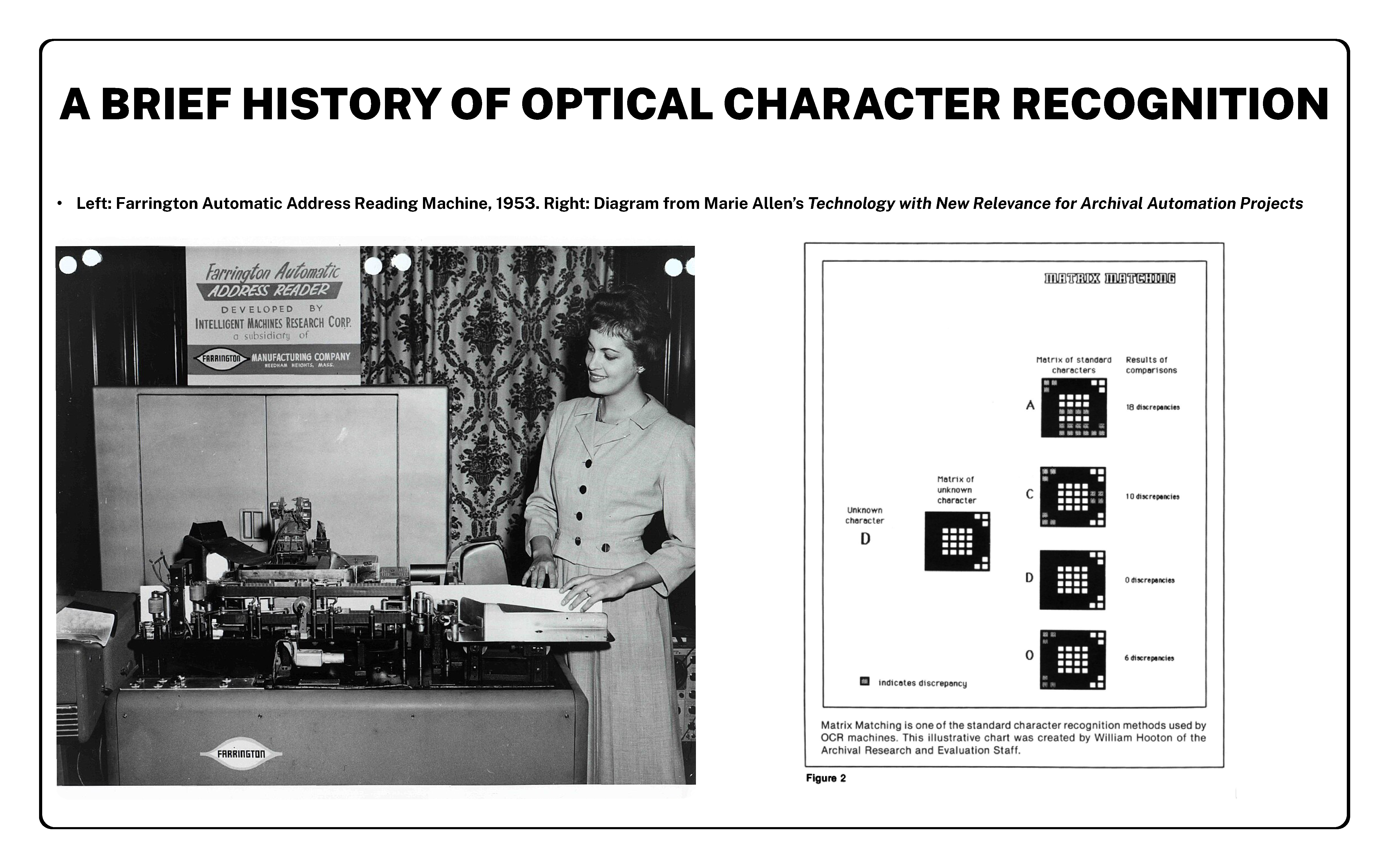
Since at least the early 20th century, inventors have developed technologies that try to “recognize” typewritten or handwritten text characters and transform them into machine-readable text, or speech or other audio tones, or punch cards, or any other format we need. The goals have usually been either accessibility, to make text more accessible to people who can’t see it or understand it, or to make the interpretation of text more efficient, for instance automating data entry. If you have a machine that can recognize individual text characters or even whole words from a page, then that information can be used for a lot of different applications. Many of the earliest OCR-type technologies were intended to make written materials accessible to people with visual impairments, recognizing text and transforming it into audio tones, speech, or something tactile. But businesses and government agencies were also early adopters of OCR machines that helped to interpret, record, and tally large amounts of written information. For instance, the United States Postal Service started using OCR around the 1960s to help sort mail automatically, and retail businesses used it to scan price tags.
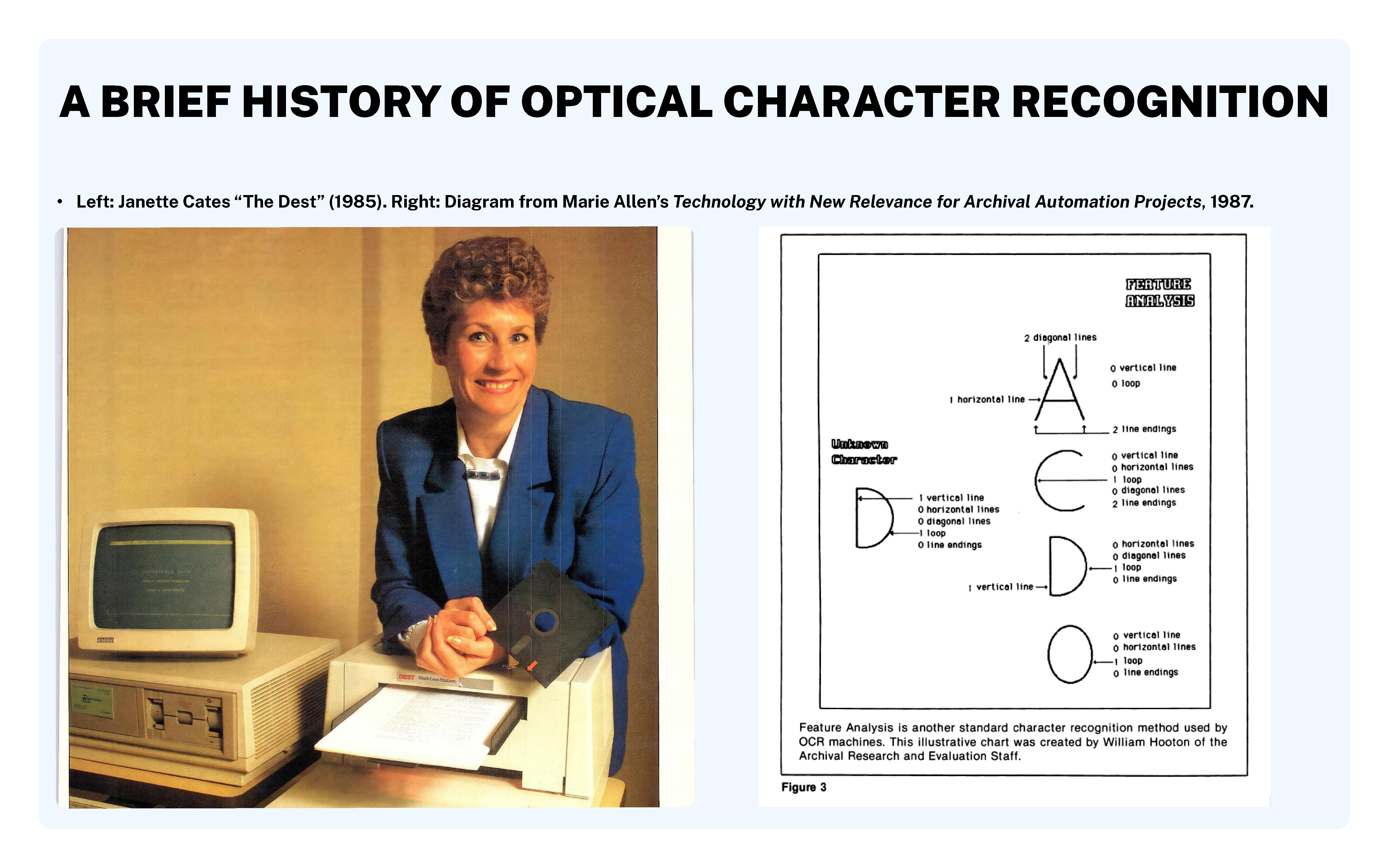
Archivists have been using OCR technology since at least the 1980s. Archivists are often slow to adopt new practices, but we want to be sure new things will truly be helpful to us, to our collections, and to researchers. Before the 1980s, OCR technologies were best used for typewritten text, preferably regularly spaced and with high contrast between the text and the page, but a lot of archival material is handwritten, messily formatted, on deteriorating paper, and so on. Then in the 1980s there were some breakthroughs with OCR technology that made it more interesting to archivists - it could do more with handwriting, especially cursive handwriting, and with low resolution and deteriorating documents. OCR offered the chance to make archival records both more accessible and more searchable, by transforming information on the page into digital text. OCR machines were also becoming smaller and less expensive, making them a more realistic option for archival institutions with smaller budgets.
For instance, in the mid-1980s, the National Archives tried out this OCR machine called the “Workless Station 213-A,” which attached to an IBM microcomputer and OCRed archival finding aids with a less than 10% error rate.
This is to say that even slow adopters like archives began to see the usefulness of OCR, and the technology has just kept improving in recent decades. In the early 2000s, online OCR services started popping up, and more applications, such as Adobe Acrobat, started incorporating OCR. And as AI technologies have advanced in recent decades, they have been employed to boost the effectiveness of OCR technology, always with the goal of making it faster, more accurate, or more widely available (or monetizable). But as we’ll discuss in this presentation, these improvements in AI-assisted OCR can come with ethical challenges for those who use it.