Findings and Future Work
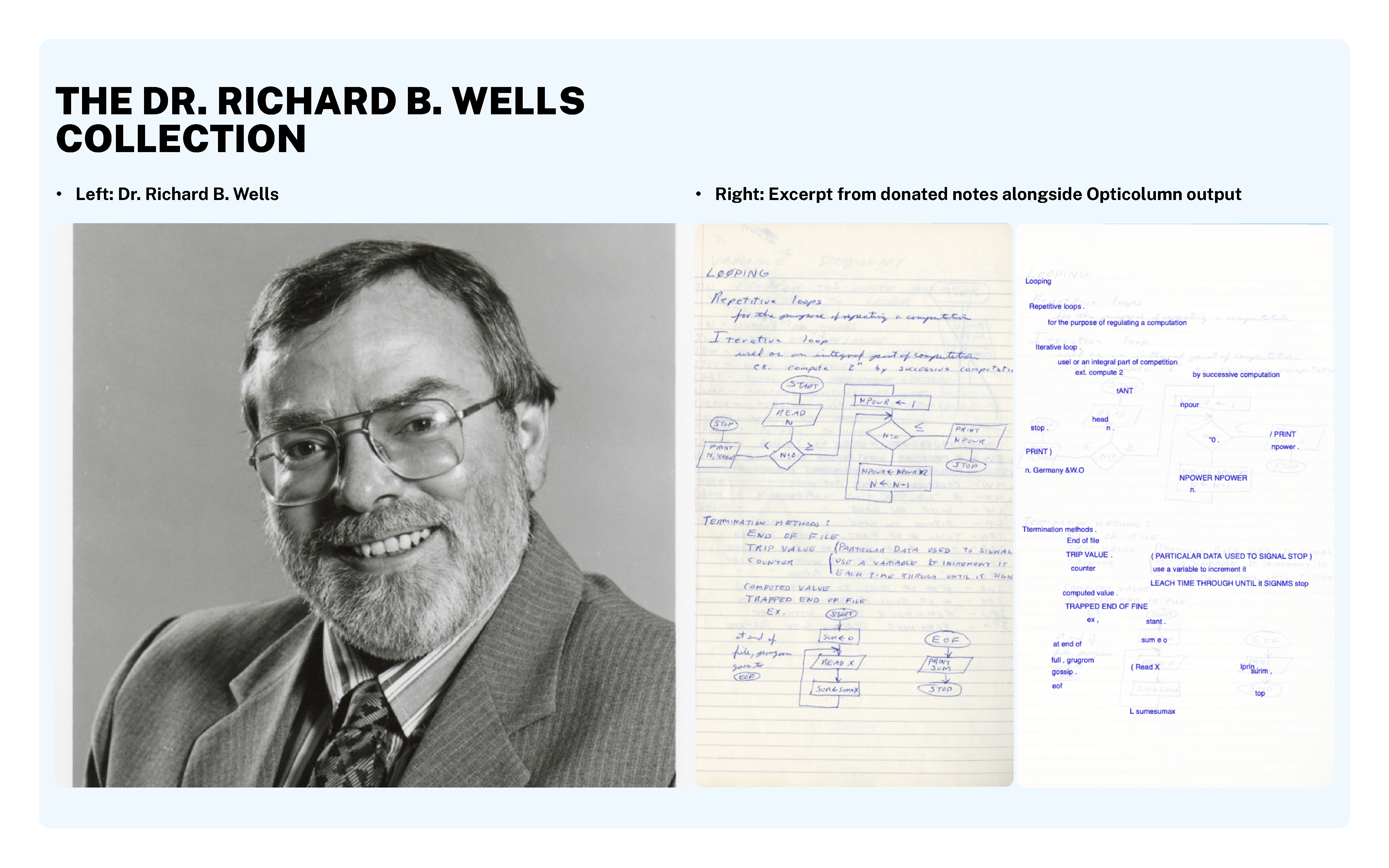
After the fourth iteration of the model, Rebecca and I happened to be working on the Dr. Richard B. Wells Collection, a digital collection that turned out to be an excellent test subject for the tool. Richard B. Wells taught electrical engineering at the University of Idaho from 1983 to 2013. His family donated his notebooks, lab work, manuscripts, and monographs to the archives after his death in 2024. Most of the collection is handwritten and spans disciplines including coding and information theory, computational neuroscience, cognitive computing, and philosophy, especially Immanuel Kant’s work.
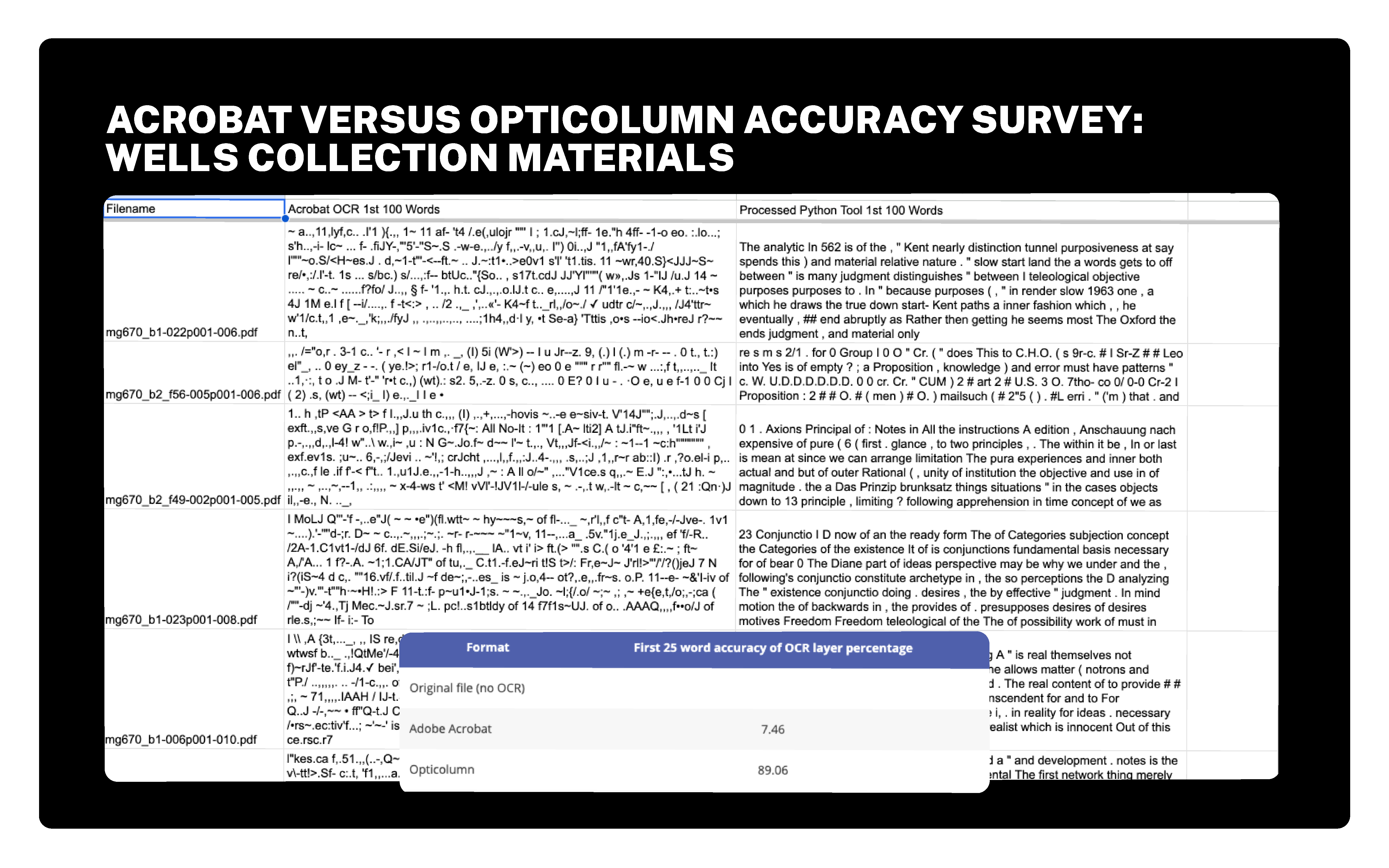
These statistics compare OCR accuracy between Adobe Acrobat’s most up-to-date version and our in-house “Opticolumn” tool across thirty handwritten documents in the Wells collection. Inaccurate words are identified as those misspelled or missing from the first 100 words of each document.
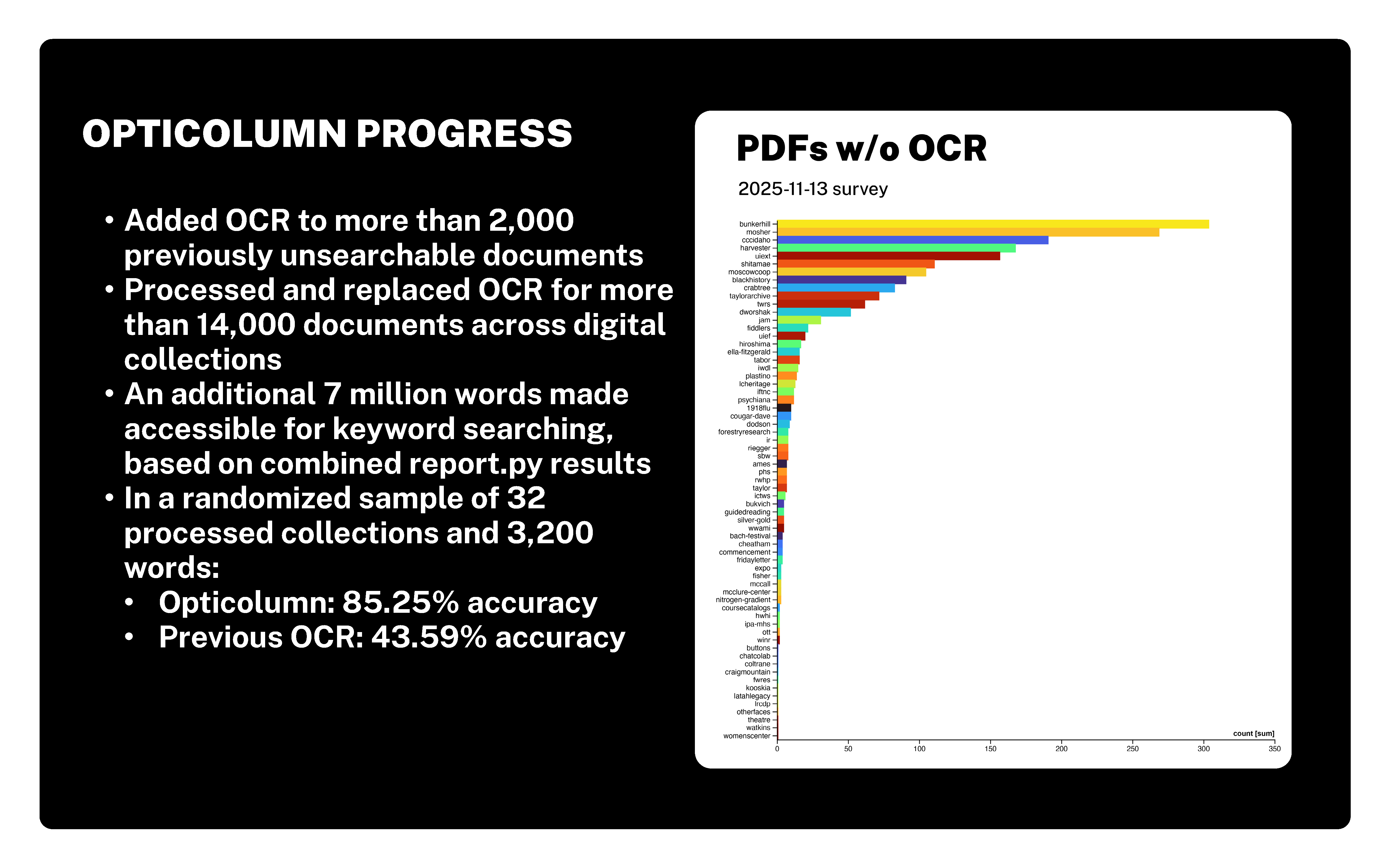
In Spring 2026, I received approval to reprocess all of the PDF files in our digital collections with Opticolumn. To approach the remediation strategically, I worked on another tool that scans all of the folders on our archive drive and tallies how many PDF files in each folder are missing an OCR layer. I used this as a guide to prioritize which collections to process first.
Working with Digital Labs Manager (and AV Specialist for the Renfrew series) Kevin Dobbins, we have now processed and replaced OCR for more than 14,000 documents across our digital collections and added OCR to more than 2,000 previously unsearchable documents. Based on combined post-processing reports, this has made an additional 7 million words accessible for keyword searching. A human-driven randomized sample of documents from 32 digital collections was used to compare processed collections, using 100 words from each document evaluated for accuracy. Collections lacking an existing OCR layer were excluded from the sample. In this survey, Opticolumn achieved 85.25% accuracy, compared with 43.59% for the previous OCR. A link to the repository containing this dataset is on the landing page for the presentation site, which we will share again at the end of this talk.
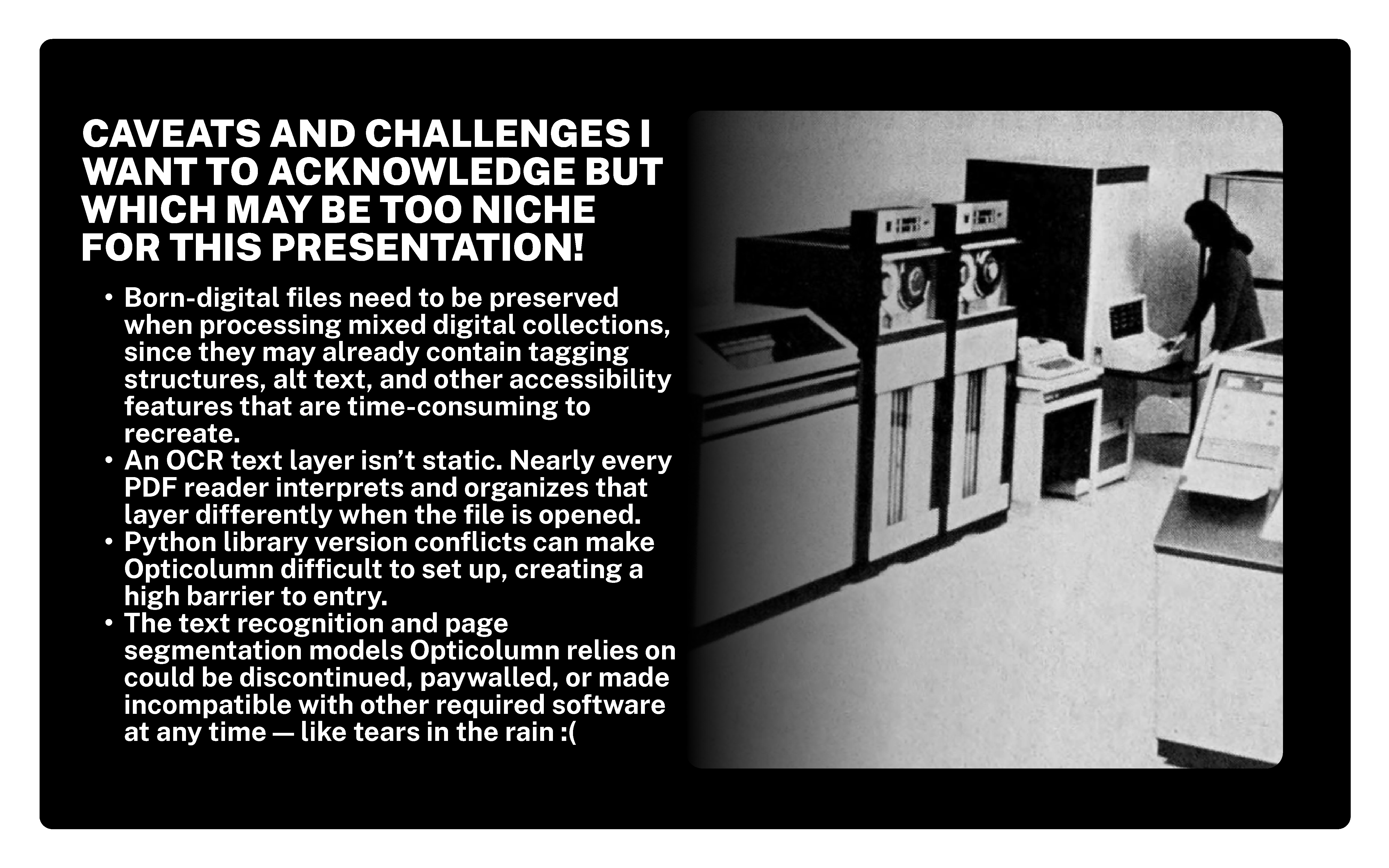
There are a few challenges surrounding this project that I want to acknowledge only in bullet points here, as they may be a bit niche to spend much time on in this talk, but I’m happy to discuss further afterward. In short, the diversity of our digital collections led me to build an auditing workflow into Opticolumn, combining a quick, image based reference to OCR accuracy and how it maps onto the page, and a text mining based report to tally the number of “true words” in the original folder versus the processed folder. These batch methods are less precise than the human-directed sample survey just mentioned, but they were helpful for confirming a large-scale project is on the right track.
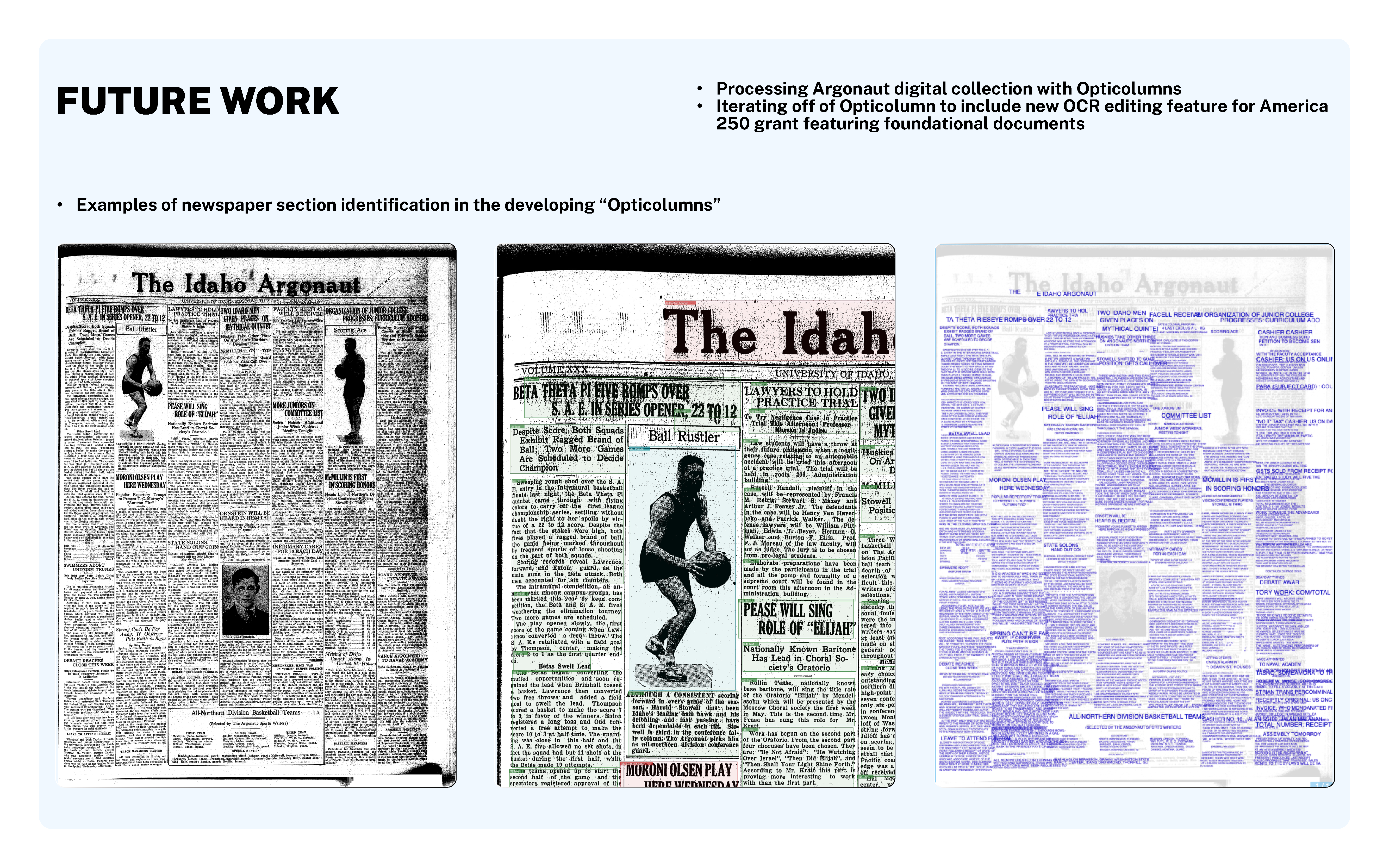
Now that all of the collections that contained documents missing OCR have been reprocessed, I’m going to start working on our newspaper collections, which are notoriously difficult to order accurately. These will be processed using another version of the tool, which uses a more advanced pattern recognition and page segmentation model that can identify all of the various elements in a newspaper page.
Working with Head of Special Collections Dulce Kersting-Lark to create accessible versions of very antiquated documents for an America 250 grant has presented another opportunity. To help make some of this ornate cursive material more accessible, I’ll be working on another function that creates an intermediate CSV of the OCR output, which can be spot-checked and edited for accuracy, then the files can be processed a second time to incorporate these revisions into the final embedded OCR layer.
What follows are practical takeaways for institutions considering a similar path, drawn from the successes and stumbling blocks of our own implementation.